Justin Seaman was leaving one emergency when he got the call for another: A car and its driver had plunged into the Inner Harbor.
He knew the only other vehicle at the Locust Point Fire Station was out for a car fire, so his crew raced back to grab the scuba gear before heading to Pier 5. When he arrived, Seaman, a two-year diver on a team of 19 with the Baltimore City Fire Department, immediately began dressing in 100 pounds of gear. Their detour to grab the equipment, while necessary, had delayed their arrival.
He suited up so fast that the sturdy-built diver forgot to put on thermals that would keep him warm in the 53-degree water that day on Nov. 18.
“I was focused on getting her out no matter what,” Seaman said.
It isn’t often that the Baltimore City Fire Department’s dive team is called into action. They can receive over 30 calls in a year, 10 of which usually become active rescue missions, Captain J. Clark Cathey said. Most notably, they were called to do emergency water rescues when the Francis Scott Key Bridge collapsed in March 2024.
“It’s more mental than physical,” said Jerry Smith, a BCFD emergency vehicle driver who has been a member of the dive team for 20 years.

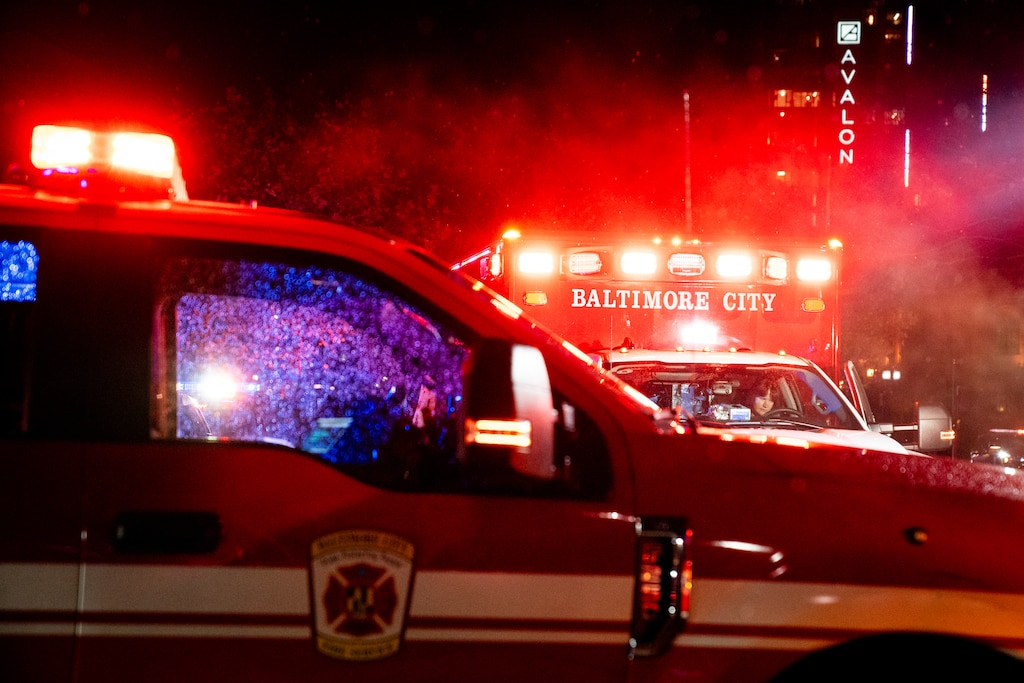
Last month, crowds gathered along the sides of Pier 4 and 5 shortly after the red Chevy sedan accelerated into the water and then slowly started to sink. It was just after 6 p.m., dark and raining.
People screamed and called for help. Others took videos as the car floated from one side of the pier to the other in minutes. The trunk popped open just before it submerged.
Cathey, who helped lead the dive, started interviewing those who had seen the car go down, digging for details that would help his team locate the vehicle as quickly as possible. Seaman was listening to the conversations as he got dressed. Cathey told Seaman he should complete a “pendulum dive,” meaning he’d go underwater at the bulkhead and swim from side-to-side until he reached the vehicle.
But after listening to witnesses, Seaman felt confident they could do a “pop dive,” or have him swim out and dive directly above where they estimated the car had gone down. The two agreed, and after safety checks of his gear, he splashed in, swimming out until Cathey told him to stop and descend.
The divers consider an operation to be a rescue for up to 90 minutes in cold water incidents, though 30 minutes can be enough time underwater to do neurological damage. Outcomes for victims can vary depending on air pockets, water temperatures and other factors. Cold water can increase a person’s chances of survival.

When the car hit the floor of the harbor, 21 feet down, it remained nose down, so Seaman landed in the car’s trunk. This can be a risky position for divers because the vehicle can move or fall more easily as they navigate it.
Visibility is low in the murky waters around Baltimore, especially after sediment on the floor is kicked up. Smith said the divers act as “bottom feeders,” often using their hands and small flashlights to find targets close to the harbor floor.
After doing a quick search of the trunk, Seaman maneuvered his way down to the passenger’s side, being careful not to destabilize the car. He tried both doors on that side, but they were locked. The windows were also tightly closed.
Swimming toward the driver’s side, the cable that allowed him to talk to his colleagues got caught on the bumper. If things go wrong in the dark waters, the dive team is trained to lower their heart rate and control their breathing to power through emergencies. He quickly got himself loose and continued on.
When he tried the driver’s side door, Seaman could tell it felt different.
“I just put some more oomph into it, pulled the door open,” Seaman said.
The only other emergency dive team in the city is with the Baltimore Police Department’s Underwater Recovery Team. The fire department’s role is to do rescues, while the police officers who are tasked with responding to water incidents are often in charge of recovery, officials said. The two teams work in tandem at times, as they did in their efforts to recover victims over the large search grid after the Key Bridge collapsed.
Throughout the dive, Seaman was talking with Cathey, who was manning the communications line to the divers. Once Seaman arrived at the door, Cathey sent a second diver, Lt. Erik Ryan, into the water.
While Seaman and Ryan have each been with the fire department for over a decade, they both joined the dive team two years ago as part of the same training cohort. To join the exclusive group, potential divers have to pass strict requirements and 18 months of mandatory training.
It’s one of the few teams in the fire department that trains every person to do every role: everyone can dive, drive the fire boats, man the comms line and do security checks.


“The saying on the dive team is there is no rank on the dive team,” said Seaman. “Everybody’s opinion matters, and we all work together.”
After Seaman first hit the water, it took the two men about 4 minutes to bring the victim to the water’s surface. The driver, whom officials later identified as 52-year-old Danielle Younger, was taken by ambulance to the hospital, where she was in critical condition.
Days after Seaman and Ryan rescued the woman from the harbor, Younger died from her injuries. Her death was ruled a suicide by the state Medical Examiner’s Office.
A few weeks later on a December morning, the fire department’s team met for training on the Bond Street Wharf, taking turns diving and searching for baby dolls with weights on them randomly thrown into the water.
Seaman reflected on the woman he had pulled out of the harbor.

Younger was submerged underwater for about 31 minutes. It did not shock the longtime firefighter that she didn’t survive.
“In our time in the fire department we’ve all pretty much realized that not every person you rescue is saved,” Ryan said.
He hoped, at the very least, their work gave the family extra time to say goodbye to their loved one.


Comments
Welcome to The Banner's subscriber-only commenting community. Please review our community guidelines.